
Nature and growth in the Oxford-Cambridge Corridor

Nature and growth in the Oxford-Cambridge Corridor

The Ambition of 100 Miles Wilder and Reconnecting Bernwood, Otmoor and the Ray

The Oxford-Cambridge region is entering a period of profound change. New homes, transport infrastructure and economic development are planned at a scale that will shape its landscapes and communities for generations.

This growth is unfolding at a time when wildlife is declining, habitats are fragmented, rivers are under increasing pressure and the effects of a changing climate are becoming harder to ignore. Record temperatures, droughts, wildfires and floods are no longer distant warnings. They are affecting people, wildlife and places across our region.

These challenges are connected. Our health, prosperity and quality of life depend upon the natural systems around us; landscapes that hold water, soils that sustain food production, habitats that store carbon, trees and wetlands that help cool our towns, and accessible green spaces that support healthier communities.

Successful growth cannot be measured only in new homes, infrastructure, jobs or economic output. It must also be measured by whether the places we create are healthy and resilient, whether communities benefit, and whether nature is recovering.

This thinking lies behind 100 Miles Wilder, BBOWT’s vision for the Oxford-Cambridge region, and our Reconnecting Bernwood, Otmoor and the Ray project.
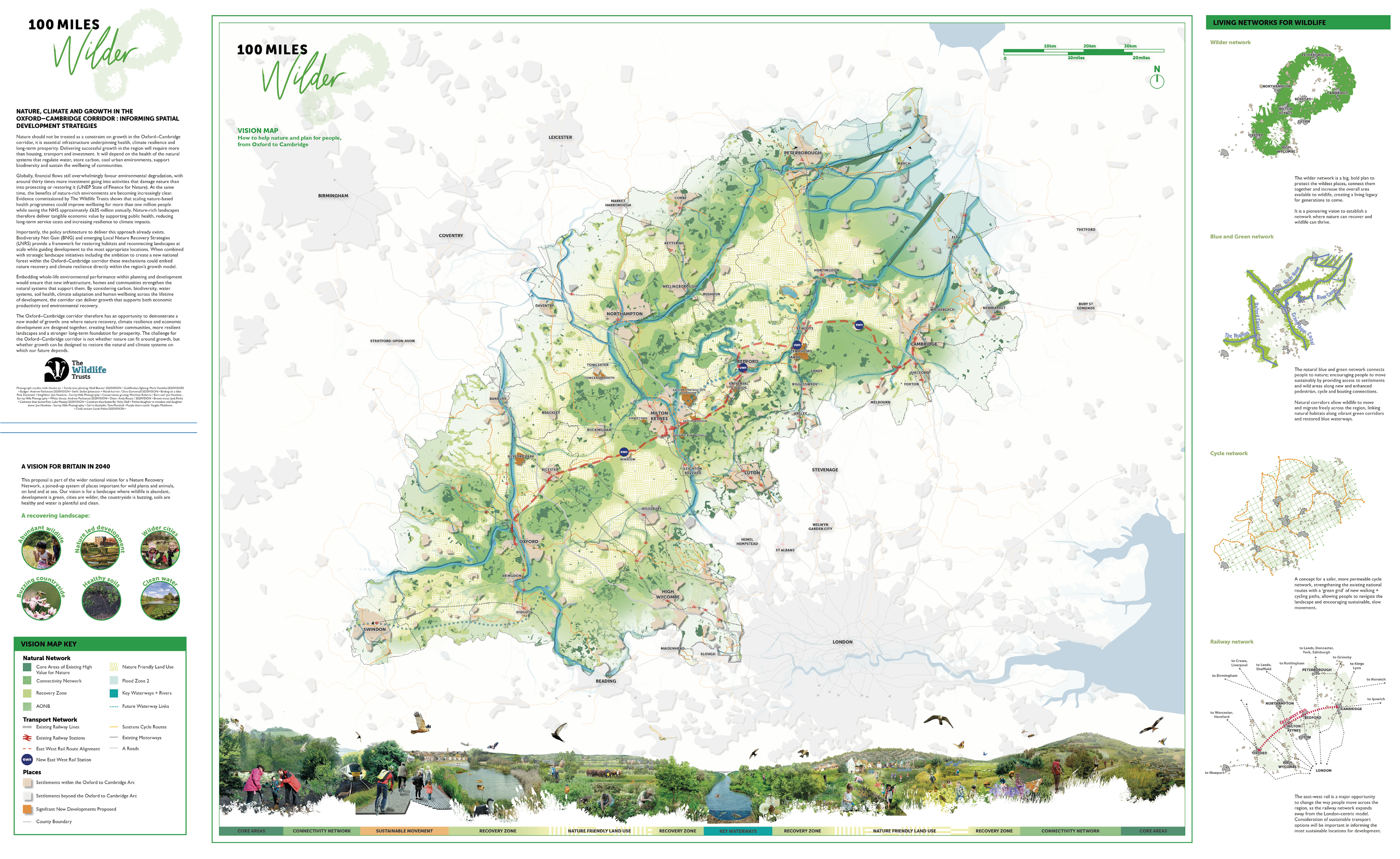
100 Miles Wilder Vision Map

100 Miles Wilder maps a connected landscape from Oxford to Cambridge in which nature-rich places and ecological networks help shape where and how development happens. It moves us beyond trying to fit nature into the spaces left after decisions have been made. Nature's recovery, climate resilience, development and community wellbeing must be planned for together as one interconnected system.

Nature is not an optional addition to growth, nor simply a constraint to be overcome, it is essential infrastructure. The health of our rivers, soils, woodlands, wetlands and other habitats will influence whether this region can respond to water scarcity, rising temperatures, flooding, biodiversity loss and the needs of a growing population.

The Government has made the Oxford-Cambridge Growth Corridor a national priority for housing, infrastructure, innovation and AI. This creates both immense pressure and a rare opportunity. If we begin with the living systems on which the region depends, growth could help restore landscapes, strengthen communities and create healthier places in which to live and work.

Reconnecting Bernwood, Otmoor and the Ray is our way of putting this thinking into practice.

The Bernwood, Otmoor and Ray landscape covers approximately 370 square kilometres between Oxford, Bicester and Aylesbury. It is one of the best remaining ecologically important, but fragmented, landscapes in southern England.

Ancient woodlands, species-rich grasslands, floodplain meadows, wetlands, rivers, hedgerows and farmland form a rich mosaic of habitats. The landscape supports rare and threatened species, including curlew, black and brown hairstreak butterflies and Bechstein’s bats. It also carries a deep farming, social and cultural history.

Yet these habitats have become increasingly isolated. The River Ray is affected by pollution, and the wider landscape faces pressure from development, infrastructure, intensive land use and a changing climate.

Curlew walking across a meadow in early morning light

Curlew by Mark Hamblin/2020VISION

Reconnecting Bernwood, Otmoor and the Ray, supported by the National Lottery Heritage Fund, is a partnership between BBOWT and eleven other organisations, working alongside farmers, landowners, communities, councils and others who know and care for this landscape. Together, we are listening, building relationships and developing plans for nature's long-term recovery. This includes exploring how habitats can be restored and reconnected, how threatened species can be supported, how farmers and landowners can be enabled to act, and how more people can participate in shaping the future of the places where they live. Additionally, the project is a strategic delivery project for Local Nature Recovery Strategies, delivering 74% of Oxfordshire’s LNRS priority measures and 51% of Buckinghamshire’s priority measures.

The landscape is already full of knowledge, care and activity. Communities are looking after local green spaces, farmers and landowners are managing important habitats, and organisations are working to protect wildlife and heritage. RBOR can help connect that work, bring people together and create the conditions for action at a much greater scale.

Its ambitions are ecological and human. We want curlews to continue calling across the floodplains, hedgerows to provide living routes through the countryside, and rivers and wetlands to support richer ecosystems. We also want more people to be able to experience and care for the landscape, to discover its natural and cultural history and to feel that they have a meaningful part in its future.

That is where the relationship between RBOR and 100 Miles Wilder becomes important.

100 Miles Wilder provides the wider spatial vision; a connected region in which nature recovery, climate resilience, communities and development are considered together. RBOR is one place where partners can begin translating that vision into practical, locally shaped action.

It can also provide valuable learning. By working across organisational boundaries and listening to farmers, landowners and communities, we can better understand what is needed to restore a landscape while it is experiencing substantial change. That learning can help inform decisions elsewhere in the Oxford-Cambridge region.

Members of the RBOR project attending a hedge workshop

Members of the RBOR project attending a hedge workshop. Photo by Emily Coulam

Over the next decade, I want to see a region in which nature is recovering and communities are benefiting from that recovery. I want children to grow up knowing the call of a curlew, more people to have access to nature close to home, rivers to become healthier and habitats to become larger and better connected.

I want economic decisions to recognise the value of healthy living systems not as an additional benefit, but as part of the foundation for long-term prosperity.

100 Miles Wilder and Reconnecting Bernwood, Otmoor and the Ray express this ambition at different scales. One helps us see the connected region we could create, the other begins with a particular landscape, its wildlife, its history and the people who belong to it. This region can be a national example of how nature's recovery and economic growth can succeed together.

100 Miles Wilder and RBOR offer a way to approach growth differently: by understanding the living systems already present, restoring what has been fragmented and enabling people to participate in shaping the future of their place.

The opportunity before us is not simply to accommodate nature while the region grows, it is to make nature’s recovery part of what progress means.